
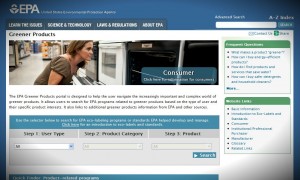
EPA Launches “Greener Products” Portal

In celebration of Pollution Prevention Week and amid an atmosphere of intelligent concern for the environmental health and safety of products we use in every day life, the EPA has launched a simple online guide for the eco-labeling  programs it supports; the Greener Products Portal.

Consumers, small businesses, retailers, manufacturers, and institutional purchasers can use the Portal to search for products that are included in EPA-approved product labeling systems. Using a set of 3 drop down boxes to narrow their inquiries folks can find information on a wide range of products; from appliances to building materials, from automotive products to cleaning products. This tool can be useful for a wide range of people; from parents to industrial purchasers, and the many demographics in between.

For those most concerned with energy efficiency and e-waste, there is an electronics category that contains a label for most items you can think of. For example; how can you identify the most ec0-friendly computer monitors, and which programs cover them? Take a look:
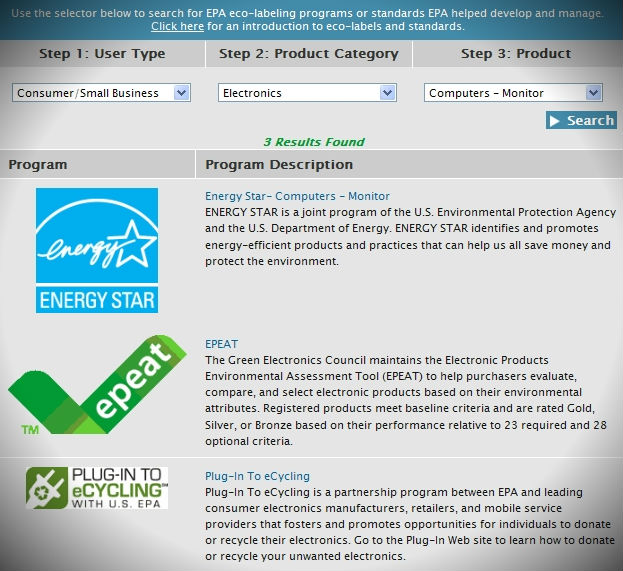
Currently, the most prevalent labeling system to appear when testing several different types of electronic products is, of course, Energy Star. It is refreshing, however, to note that in addition to this familiar energy efficiency marker, there are other labeling systems in place for some electronic pieces- two of which are visible above.

In addition to the searching methods previewed here, you will also find a Greener Products FAQ section in a menu to the right side of the web page.

Take a look at this valuable new resource today to gain a better understanding of the products you use at home or in the workplace!

NEW! Online Interactive Home makes Energy Efficiency an Easy DIY

One of the most exciting intern projects completed this summer is a new component of our website: an online Interactive Home.

Clicking on different household components will bring you to information about DIY energy saving projects and renewable energy guides. In the house you’ll find know-how to install just about every energy saving measure available from upgrading to solar lighting outdoors to sealing drafts. Check every section of your home –  including doorways, refrigerators, lamps, boiler rooms, laundry machines, and more!

For example, if you would like to learn about geothermal heat pumps, click on the image of red and blue lines buried underneath the home. Clicking will open up a new tab, with concise and helpful information including a general definition, two different types of systems (horizontal-closed loop and open loop), as well as guidance on how to finance a project with state and federal rebates.

Take a look through all of the projects you could tackle with the most visually engaging and interactive guide we’ve ever offered! If you have more questions about home energy improvements, contact our Energy Advisor.

Biomass Blues

Single large tree leaning to left, Washington state by UW Digital Collections

Massachusetts Governor Deval Patrick’s stance on biomass has recently changed its tune from one of skepticism to one of acceptance as a state-wide “clean” energy policy. Why the sudden switch? State environmental groups, the same groups who helped lobby to get him into office, are wondering the same thing and are now turning against Patrick’s newfound position at large.

According to a recent article in the Boston Phoenix, the Patrick administration will release a document in the next few weeks that will contain the final regulations for the state’s biomass subsidies.  According to environmental groups, the Administration is planning to reverse its original position as a nod towards a handful of developers who stand to make money off of biomass production.

These regulations will come at the expense of ordinary electricity-utility ratepayers who will be forced to pay extra to subsidize a practice that negatively impacts the environment and opens the way for clear-cutting of forests and increased carbon emission (carbon emissions from biomass are particularly concentrated).

Susan Reid, vice-president and director of the Conservation Law Foundation (CLF) of Massachusetts stated that, “It is deeply troubling that the Patrick administration would jettison good policy and good science.”  James McCaffrey, director of the Massachusetts Sierra Club stated: “We will be very disappointed and very upset” if the Administration doesn’t reverse course. “It is going to indicate that the industry had a real hand in weakening these regulations.”

In an effort to determine whether biomass was as dirty as projected, the Administration commissioned the so-called “Manomet Report.” The study cast serious doubt on whether woody biomass is clean at all.  Based on the Manomet Report (pdf), the Administration issued a letter to draw up regulations allowing woody biomass to qualify for subsidies only if it met certain efficiency standards.  These regulations are the very regulations environmental groups are waiting anxiously for this fall.

In addition to state-wide policy, biomass has created tension throughout municipalities and local townships.  In Greenfield, for example, many homeowners have placed anti-biomass signs on their lawns as western Mass will face the brunt of production given the vast natural resources that exist in that region of the state.

While the struggle for a clean energy economy continues to envelop both Massachusetts and national politics, the debate over biomass remains clear: do state residents wish to see increased clear cutting across the state in return for dirty energy?  In a world that is faced with the daunting impacts of climate change, perhaps we should instead focus our policy efforts on coupling energy efficiency efforts with renewables such as wind, solar and geothermal.  Trees act as carbon sinks absorbing excess carbon out of the atmosphere; going forward, it would be wise policy to instead preserve as many carbon sinks as possible.